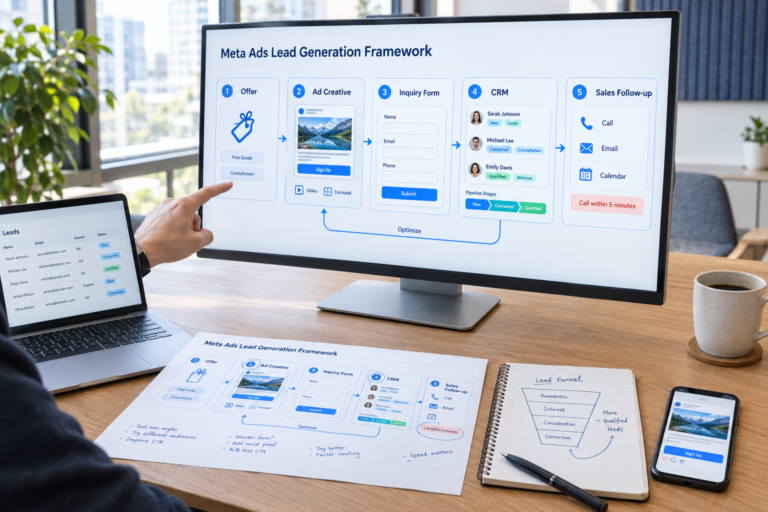
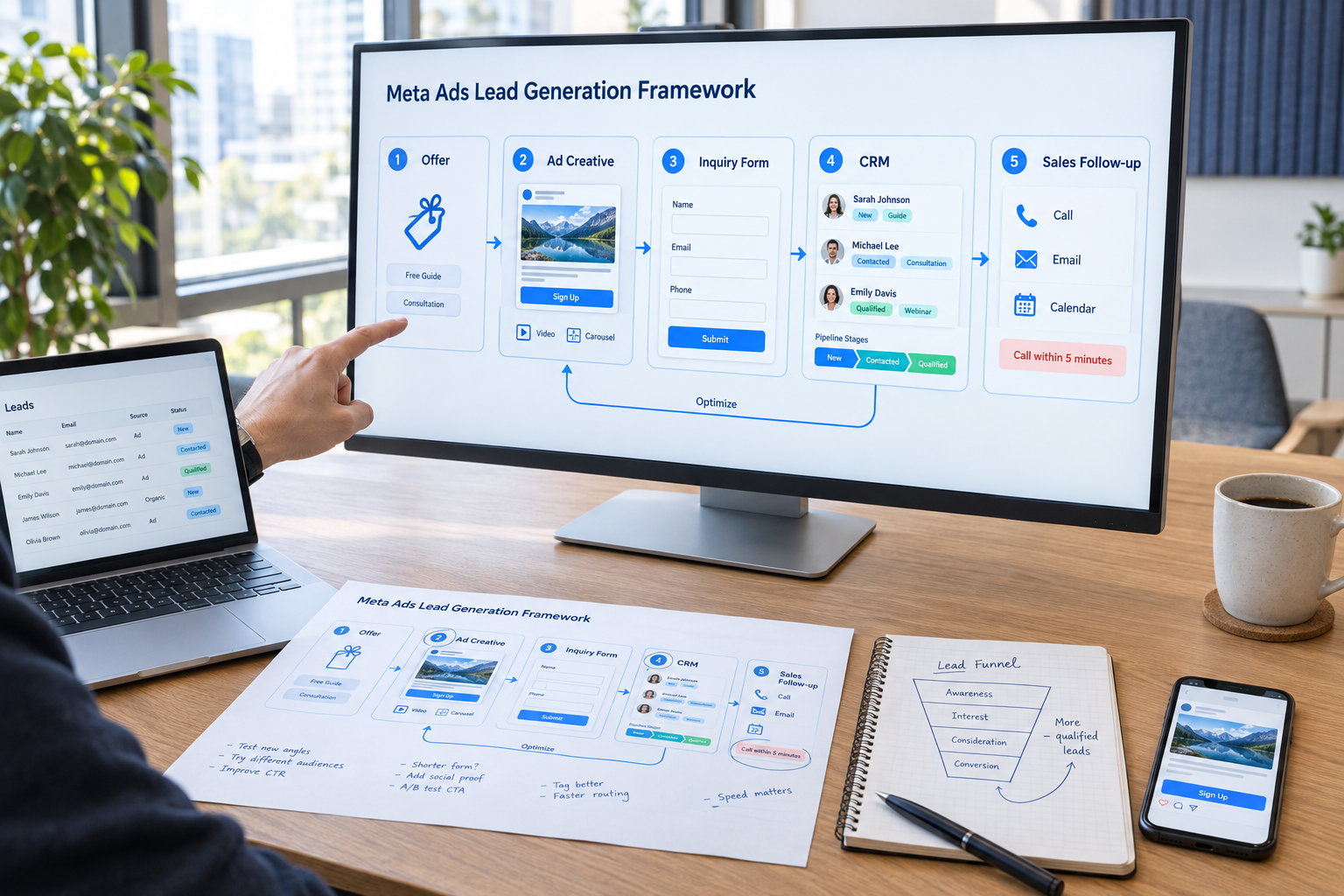
Meta Ads management services should connect advertising activity to qualified inquiries and a workable sales process. Within a broader digital marketing strategy, the objective is not simply to collect more forms. It is to attract suitable prospects and help the business move them toward a meaningful next step.
That requires coordination between the offer, audience, creative, campaign objective and conversion destination. Qualification and follow-up must be planned before the first lead arrives.
This framework explains how those elements fit together and what a service business should expect from a Meta Ads agency.
| Quick Answer Meta Ads management services combine offer planning, audience selection, creative production, campaign setup, conversion tracking and optimization. For service businesses, the framework must also include lead qualification and sales follow-up. Evaluate performance through qualified inquiries, appointments and customers, not only clicks or the lowest cost per lead. |
Build the Lead Generation Framework
Define a Qualified Lead First
Before discussing campaign settings, agree on what makes an inquiry commercially relevant.
A qualified lead might need the service you provide, be located within your coverage area and have a realistic project timeframe. Depending on the business, budget or decision-making responsibility may also matter.
Avoid describing quality only as “someone ready to buy.” That definition is difficult to apply consistently.
Create a short qualification standard:
- The requested service matches your offer.
- The project is within your service area.
- The contact details are usable.
- The expected timing fits your availability.
- Any necessary project requirements are understood.
- The sales team knows the appropriate next step.
Use the same standard in campaign planning, form design and CRM reporting. Otherwise, marketing and sales may judge the same inquiry differently.
Build an Offer Worth Responding To
An advertisement needs a clear reason for someone to act.
“Contact us for more information” leaves the next step vague. A more specific offer might be a project estimate, an introductory consultation or an assessment with a defined purpose.
Explain what the prospect receives, who the offer suits and what happens after submission.
For example, a landscaping business could invite homeowners within its service area to request a consultation about a particular project type. The ad should explain what the consultation covers rather than promise an outcome the business cannot guarantee.
Do not rely on discounts alone. Test whether clarity, useful information or a relevant service package provides a stronger reason to inquire.
Agree on the Management Scope
A paid social agency should explain which parts of the journey it will manage.
Campaign setup does not automatically include filming, landing-page development, CRM configuration or sales calls. Clarify those responsibilities before launch.
When reviewing lead generation campaign strategy, request a scope that separates media spend from management fees and production work.
| Workstream | What to clarify |
| Strategy | Offer, audience, qualification criteria and campaign goals |
| Creative | Copy, images, video, variations and revision rounds |
| Campaign management | Setup, monitoring, testing and budget decisions |
| Conversion destination | Instant form, landing page, messaging or another supported route |
| Tracking | Event definitions, testing and reporting responsibilities |
| Lead handling | CRM delivery, assignment and follow-up ownership |
| Reporting | Platform results, lead quality and downstream outcomes |
A clear scope helps prevent the advertising team from optimizing toward an outcome nobody is equipped to handle.
Match the Objective to the Outcome
Choose the campaign objective and performance goal according to the action you want people to take.
For form-based lead generation, Meta documents the Leads objective with instant forms or website forms. It also distinguishes optimizing instant forms for lead volume from optimizing for conversion leads using CRM feedback. See Meta’s lead generation form guidance.
Do not select a traffic-focused setup and assume that inexpensive visits demonstrate successful lead generation.
Agree on the conversion location, event and performance goal before launch. Then confirm which options are available in the account and suitable for the measurement setup.
Avoid treating every service business as a purchase campaign. A submitted inquiry, booked consultation and completed sale represent different stages.
Set Targeting Around Business Reality
Start with the people the business can actually serve.
Confirm geography, service availability and any legitimate eligibility requirements. Then evaluate audience signals without assuming that a long list of interests will identify the best customers.
Meta distinguishes audience controls from audience suggestions. Controls limit delivery, while suggestions can guide delivery beyond the suggested audience when the system expects better performance. Review the current audience controls and suggestions guidance.
Check whether each setting is acting as a restriction or a suggestion. Do not assume that selecting an interest or audience automatically limits delivery to that group.
Also review category-specific restrictions before planning targeting. Housing, employment and financial-services campaigns can have different available audience options.
Create Ads That Explain the Service
Creative should help the right prospect recognize relevance.
A useful service advertisement can explain the problem, show how the work is performed, address a common objection or demonstrate a completed project with permission.
Build variations around distinct ideas rather than changing only a button color.
| Creative angle | Illustrative service-business example | What it tests |
| Process explanation | Show what happens during an initial assessment | Whether understanding the process encourages inquiries |
| Customer question | Explain what affects project pricing | Whether a common concern attracts relevant interest |
| Demonstration | Show the team completing a specific task | Whether seeing the work improves relevance |
| Evidence | Present an approved customer account or project example | Whether credible proof supports consideration |
| Offer explanation | Describe what a consultation includes | Whether a clearer next step improves response |
These are testing ideas, not guaranteed winning formats.
For video campaigns, plan the footage, opening message, captions and call to action together. Video editing for advertising should preserve the offer’s meaning while adapting it to the intended placement.
Avoid exaggerated outcomes, fabricated testimonials or claims the business cannot substantiate.
Keep Organic and Paid Messaging Consistent
An interested prospect may visit the business profile before completing a form.
Review whether the profile explains the same services, location and offer as the advertisement. Remove obvious contradictions between the campaign and the information people find afterward.
A coordinated social media content strategy can provide supporting explanations, project examples and answers to common questions.
Paid advertising and organic publishing do not need identical content. They should, however, describe the same business and set compatible expectations.
Choose the Right Conversion Destination
Instant forms and landing pages offer different ways to collect inquiries.
Meta’s form guidance describes instant forms as an on-platform option and website forms as a route for experiences that need additional explanation or actions such as booking and quote generation.
| Decision factor | Instant form | Website landing page |
| User journey | Submitted within the platform experience | Requires a visit to your website |
| Explanation space | Suits a focused offer and concise questions | Allows more detailed service information and proof |
| Experience control | Uses the platform’s available form options | Depends on your website design and development |
| Qualification | Uses the supported form questions | Can support a more tailored workflow |
| Technical dependencies | Form setup and reliable lead retrieval | Page performance, form handling and website tracking |
| Evaluation | Lead quality and downstream outcomes | Lead quality and downstream outcomes |
Do not assume that a landing page always produces better leads or that an instant form always produces worse ones. Compare them using the same qualification standard.
If you choose a website destination, coordinate landing-page design and development with the ad. The page should continue the same offer, explain the next step and work reliably on mobile devices.
Ask Questions That Support Qualification
Collect information because it helps the business respond, not simply because another form includes the field.
A service inquiry might reasonably ask for the required service, location, approximate timeframe and preferred contact method. More complex projects may need additional information later.
Explain what happens after submission. If the next step is a call to understand the project, say so rather than implying that the form produces an immediate quote.
Have the privacy notice and data-handling process reviewed before launch. Meta also prohibits sharing certain sensitive information through its business tools, as explained in its event-data guidance.
Keep unnecessary sensitive details out of forms, tracking parameters and advertising event data.
Connect Campaigns to Sales Outcomes
Route Every Inquiry to an Owner
A lead should arrive somewhere that the team actively monitors.
Define who receives it, how assignment works and what happens when the assigned person is unavailable. Test the complete route before the campaign starts spending.
A practical workflow might be:
- Capture the inquiry and campaign identifiers.
- Check for duplicate records.
- Assign the lead by service, location or availability.
- Notify the responsible salesperson.
- Record the first contact attempt.
- Update qualification and appointment status.
- Record the eventual outcome.
CRM implementation and workflow automation can support these steps, but the process still needs clear ownership.
An automated acknowledgment is useful communication. It is not the same as a salesperson reviewing and responding to the inquiry.
Set a Realistic Follow-Up Standard
Agree on a response standard that the team can consistently meet.
Define business-hour coverage, handling of after-hours inquiries and escalation when a lead remains untouched. Set contact attempts and channels according to the prospect’s permissions and applicable requirements.
The first conversation should connect to the advertisement. If someone requested a project assessment, the salesperson should understand that offer before making contact.
Record why inquiries do not progress. Useful categories might include outside service area, unsuitable project, timing mismatch, duplicate submission or no response.
Do not classify every unanswered inquiry as a poor-quality lead. Review contact attempts and response handling before reaching that conclusion.
Distinguish Lead Retrieval From Feedback
Sending new leads into a CRM and sending sales outcomes back to Meta are separate tasks.
Lead retrieval gives the sales team access to inquiries. CRM feedback can send downstream events to Meta so the platform has information beyond the initial submission.
Meta’s Conversions API for CRM guidance explains this connection and the available integration approaches.
Do not assume that choosing a conversion-leads performance goal automatically completes the integration. Confirm the connection, event definitions and account eligibility.
Use meaningful stages consistently. If different salespeople apply “qualified” differently, the feedback will not represent one dependable business outcome.
Test Measurement Before Launch
Agree on what each reported event means.
A form view is not a submitted inquiry. A submitted inquiry is not a qualified opportunity, and a scheduled appointment is not an attended appointment.
Test the intended journey using representative submissions. Confirm that successful inquiries are recorded once, campaign information is retained and failed submissions are not counted as successful leads.
Also test lead assignment and notification failures. A working advertisement cannot compensate for an inquiry that never reaches the sales team.
Keep platform reporting and CRM reporting visible together. Investigate differences rather than assuming the numbers must match exactly.
Measure More Than Cost per Lead
Cost per lead is useful, but it does not describe the whole commercial result.
A campaign can generate inexpensive inquiries that rarely qualify. Another may produce fewer, more expensive inquiries that convert into customers more consistently.
| Metric | Calculation or definition | What it helps assess |
| Cost per lead | Ad spend divided by leads | Initial acquisition efficiency |
| Qualification rate | Qualified leads divided by leads | Relevance of the inquiries |
| Cost per qualified lead | Ad spend divided by qualified leads | Cost of reaching suitable prospects |
| Appointment rate | Booked appointments divided by the agreed lead population | Progress toward a sales conversation |
| Attendance rate | Attended appointments divided by appointments due | Whether scheduled conversations happen |
| Ad spend per customer | Ad spend divided by customers acquired | Media cost relative to customer outcomes |
| Collected revenue | Revenue actually received from tracked customers | Financial outcome beyond pipeline estimates |
Define the reporting window and denominator for each measure.
For longer sales cycles, review lead cohorts after they have had enough time to progress. Comparing this week’s new leads with last month’s completed sales can produce misleading conclusions.
Compare Two Illustrative Campaigns
Consider two hypothetical campaigns for the same service business, each spending $2,000 during a comparable period.
| Measure | Campaign A | Campaign B |
| Ad spend | $2,000 | $2,000 |
| Leads | 100 | 80 |
| Cost per lead | $20 | $25 |
| Qualified leads | 20 | 40 |
| Cost per qualified lead | $100 | $50 |
| Customers acquired | 4 | 8 |
| Ad spend per customer | $500 | $250 |
Campaign A has the lower cost per lead. Campaign B produces more qualified leads and customers in this example.
These figures are illustrative, not client results or expected performance.
Ad spend per customer also excludes management fees, creative production and sales costs. Include those when assessing total acquisition cost and profitability.
Improve the Weakest Stage
Use the complete journey to decide what to change.
| Observed problem | What to investigate |
| Ads receive attention but few inquiries | Offer clarity, destination experience and form function |
| Many inquiries fall outside scope | Messaging, geographic settings and qualification questions |
| Suitable leads do not receive contact | Assignment rules, notifications and staff availability |
| Appointments are booked but missed | Expectations, scheduling friction and reminders |
| Qualified conversations rarely become customers | Service fit, sales process, pricing and proof |
| Reported leads do not match CRM records | Integration, duplicates and event definitions |
Avoid changing every component at once. Choose a clear hypothesis, define the measure and record what changed.
For meaningful comparisons, keep the qualification standard and reporting period consistent.
Scale With Operational Capacity
Do not increase spending solely because a campaign has generated inexpensive leads.
Check whether the sales team can respond, appointments are available and the business can deliver the service. Increased inquiry volume should not create longer delays or an unreliable customer experience.
Keep advertising spend, creative costs and management fees separate in the budget. Set a test budget according to commercial constraints and the evidence needed for a decision, not a universal daily-spend rule.
Evaluate performance as spending changes. Results at one budget do not guarantee identical economics at a higher budget.
Contact Us
Prepare your service area, offer, current lead volume, qualification criteria and sales follow-up process before requesting campaign support.
Use the Contact Us page to discuss Meta Ads management services with TFF Digital and define responsibilities for creative, campaign management, landing pages, tracking and lead handling.
Frequently Asked Questions
What Do Meta Ads Management Services Include?
The scope may include strategy, audience planning, creative production, campaign setup, monitoring, testing and reporting. Confirm whether landing pages, CRM integration and lead qualification support are included or separately scoped.
How Do Facebook and Instagram Campaigns Connect?
Facebook Ads management and Instagram advertising services should support the same offer and qualification standard while adapting creative to the intended placements. Evaluate results against business outcomes rather than treating each platform as an isolated activity.
Should I Use Instant Forms or a Landing Page?
Use the experience that fits the offer and information needed before inquiry. Instant forms support an on-platform submission, while landing pages allow more explanation and tailored website actions. Test quality and downstream outcomes rather than assuming either format is always superior.
Can a Meta Ads Agency Guarantee Leads?
A provider can commit to defined work, monitoring and reporting. Treat guaranteed lead quality, customer numbers or revenue cautiously because results also depend on the offer, market, budget and sales process.
How Much Should a Service Business Spend?
Set the budget around customer economics, available capacity and the scope of the test. Separate media spend from management, creative and integration costs before deciding whether the program is affordable.
Why Are My Leads Not Converting?
Review service fit, contactability, follow-up, appointment attendance and sales handling separately. A low conversion rate may involve the advertising, the offer, the response process or several stages together.
What Should I Ask a Paid Social Agency?
Ask how it defines qualified leads, selects objectives, tests creative, validates tracking and incorporates sales feedback. Request a clear explanation of account access, asset ownership, fees and reporting responsibilities before approving the engagement.